Perimenopause Messing With Your Mind?
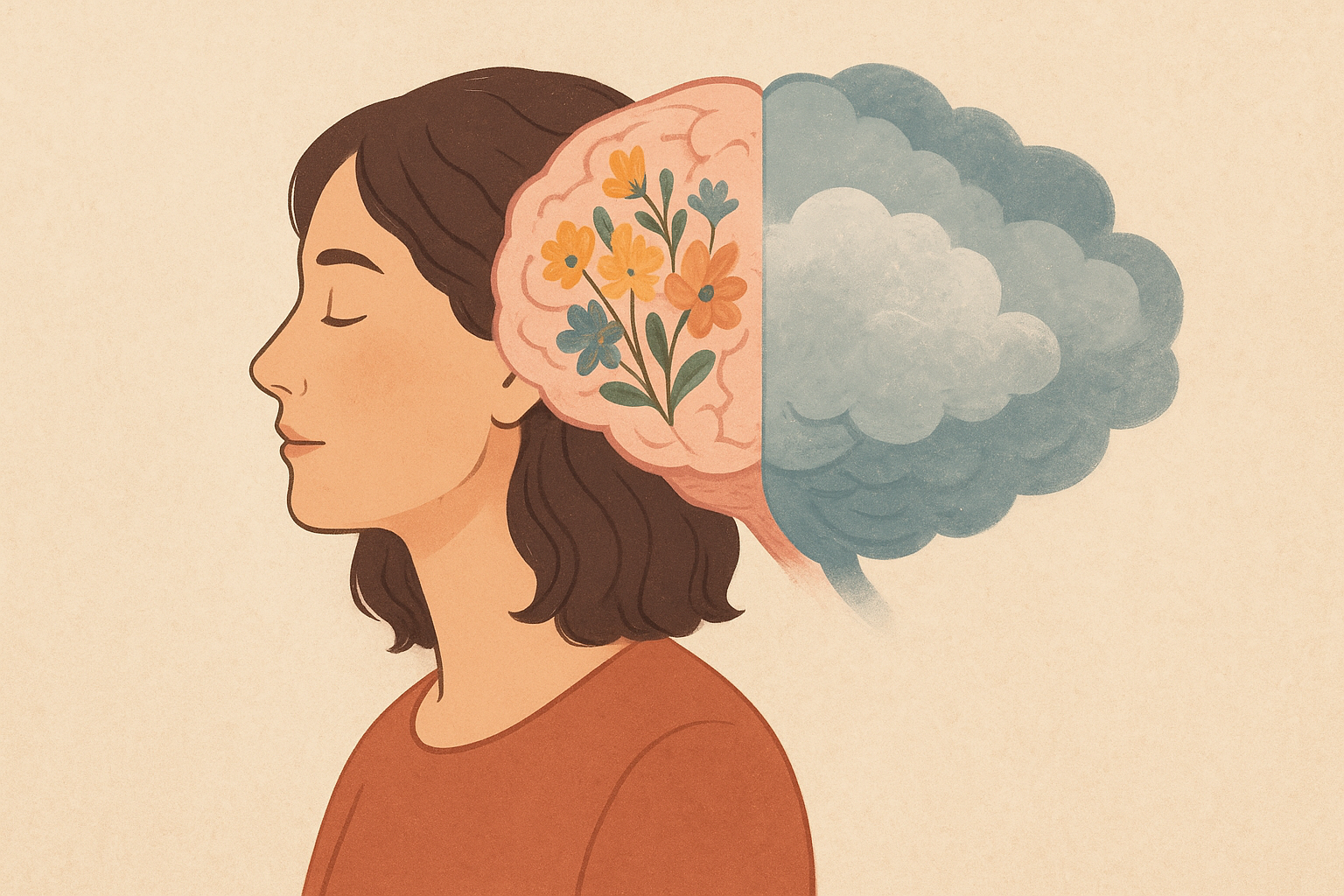
You are Not Alone
“The absence of mental illness doesn’t mean the presence of mental health.Even if you’re not depressed or burned out, you might be languishing—feeling a sense of emptiness and stagnation. Meh. Naming it is a step toward lighting a path out of it.” — Adam Grant
At the core of whole person health is the understanding that your body, soul, and spirit are intimately and intricately related, for better or for worse. What happens in your spirit and soul (your mind, will, and emotions) impacts your cells. Likewise, the health of your cells, tissues and organs impacts your emotions, your thoughts, and your relationship with God and others.
I never really thought about all of this in the context of perimenopause until I was knocked off balance by my changing hormones a few years ago and felt its effects on my whole person.
The average age of menopause is 51/52, but 7-10 years before that is when your hormones start to shift as your ovaries reach the end of their life span and become more stubborn and less predictable along the way. Such hormone unpredictability offers a powerful example of how your body impacts your soul (and also your spirit, as the state of your mind impacts how you relate to God).
As my friend Michelle shared in a recent Facebook post: “In perimenopause, estrogen and progesterone don’t follow the predictable monthly pattern they once did. Instead, they loop and spike — sometimes giving you two “mountain peaks” in a single month. These out-of-phase hormone surges can bring unexpected symptoms: mood swings, sleep disruption, heavy or irregular cycles, fatigue, and emotional overwhelm.”
Here are some of the ways I believe my mental health has been impacted by my changing hormones:
- Going from hardly ever crying to experiencing sudden, unexpected waves of tears. This happened to me just the other day at a school staff meeting.
- Waking up at 2 AM and unable to get back to sleep…for multiple days in a row. Not sleeping leading to stress about sleeping. Getting into my head about it and wondering if and how it will ever end, only to experience it suddenly end as quickly as it began.
- Waking up one day and just feeling off. Life may be OK, good, or even great, but I’m off. I can’t put my finger on it and can’t find an emotion word to describe it. The other day I learned that this is one of the first symptoms of the perimenopause transition and even has a name – IDFLM (I Don’t Feel Like Myself). On these days it’s helpful for me to tell my husband that I’m off so that he doesn’t take it personally when I get quiet or need some space. He usually already knows before I tell him, though, because he can read it on my face.
- Feeling energized, creative, bold, confident and secure one day, and then exhausted, numb, discouraged, unmotivated, and insecure the next.
- Upbeat and positive, and then seemingly suddenly irritable with a depressed mood. I’m in that latter place as I write this.
- In relationship with God and feeling close and connected one day, and distant and far away the next.
- Brain fog and memory issues. It is so embarrassing when I suddenly can’t come up with names of people that I know, sometimes in their presence. What a relief to know that this also is common in perimenopause.
Of course, there are MANY other reasons for mental health changes and challenges, and it would be wrong to make a blanket assumption that estrogen is at the root of it all. However, if and when you notice a change from your usual in the way that you relate to yourself, to others, and to God in this world, and you are in the season of life when your hormones are changing, you owe it to yourself to try to understand how your hormones may be playing a part. Because here’s the reality:
- Women face their greatest mental health risks during midlife.
- Women undergoing perimenopause may be about 40% more likely to experience depression compared to before menopause.
- Data from the Centers for Disease Control and Prevention (CDC) show that for women in the U.S., suicide rates have been highest among the age group 45–64 years for many years.
Powerful shifts occur in our brain during perimenopause and menopause because hormones like estrogen are not only signals to our reproductive system. They also play key roles in our brain energy, our memory, regulation of our emotions, and more. The good news is that there are many ways we can support our brains as we move intentionally through this season to a place of lifelong brain resilience. Perhaps I’ll write about that next. But the first step for so many women is awareness, as it was for me. I hope and pray that I’ve given you something to think about when it comes to your brain and mental health as you age.
And to end with some good news: while perimenopause can feel like an emotional whirlwind, research offers an encouraging truth: on the other side of this transition, most women experience greater balance, steadiness, and well-being. As hormone fluctuations settle, anxiety and mood swings often ease, sleep and clarity improve, and many women report feeling more grounded, peaceful, and confident than they have in years. Large international studies like the Global Flourishing Study even show that emotional well-being often rises in midlife and beyond. In other words, this difficult season is not a permanent state — it’s a passage. And for many women, what comes after is a renewed sense of strength, clarity, and flourishing.